
Platform · Wealth
Portfolio management: from model strategy to controlled rebalance
Model portfolios, drift monitoring, validated rebalancing, fees and performance across every client account, for asset managers, wealth managers and private banks.
In short
ZagTrader Portfolio Management & Wealth gives asset managers, wealth managers and private banks one workflow from model strategy to executed, allocated and reported rebalance: target allocations, drift monitoring, controlled rebalancing with pre-trade checks, fees and performance analytics across every client account.
- Built for
- Asset managers, wealth managers and private banks
- Replaces
- Spreadsheet models, manual rebalancing and hand-built fee and performance reports
- Connected to
- Trading, risk, accounting and reporting on the same platform
What you get
The six things portfolio teams ask about first. Each links to the details below.
Model portfolios with real targets
Target allocations by market, sector, asset class, security, currency and cash, entered by hand or imported and validated to 100%.
See the detailsDrift you can see at a glance
Actual weights against targets with green, amber and red tolerance bands, down to position, sector, market and client.
See the detailsRebalancing under control
Buy and sell deltas grouped as parent orders, every child order checked before anything is sent, fills allocated back pro-rata.
See the detailsPerformance clients understand
NAV, AUM, net flows, time- and money-weighted returns and realized P&L across any period, against benchmarks.
See the detailsFees calculated, not spreadsheeted
Management, performance and success fees with benchmarks, hurdle rates and minimums, posted as draft journals for approval.
See the detailsInternal and external managers
Map strategies to managers and accounts, with manager self-service and oversight for the institution.
See the detailsPerformance, NAV & analytics
Performance is not limited to a single return number. Time-Weighted Return, Money-Weighted Return, benchmark comparisons, and attribution reporting help managers understand how a portfolio performed and what contributed to the result, across Today, MTD, QTD, YTD, 1Y, 2Y, and since-inception periods.
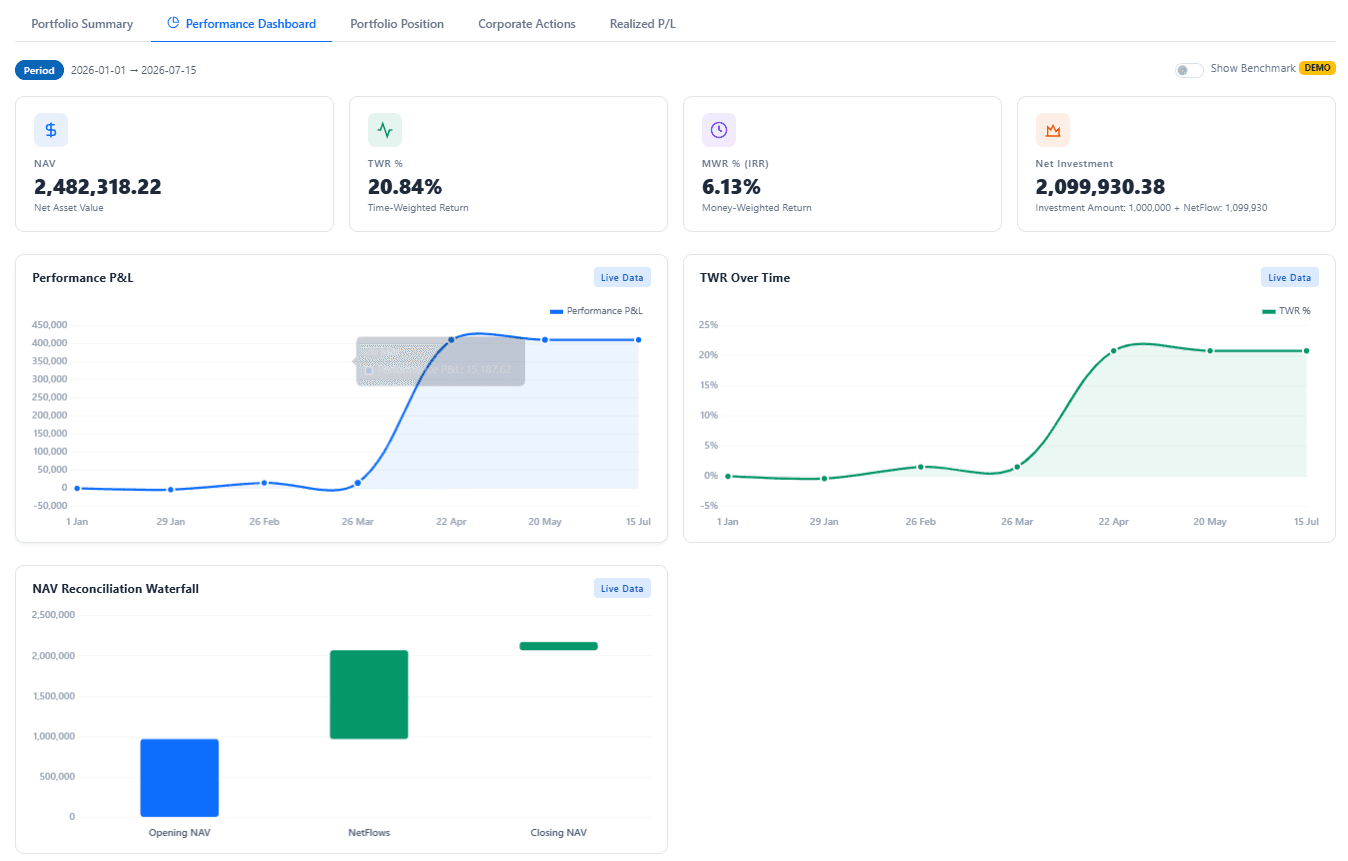
Also on the dashboard: market value, best and worst performers, monthly breakdowns, and detail views for positions, corporate actions and transactions.
Drift monitoring
Drift-monitoring and rebalancing tools compare actual portfolio allocations against their assigned strategies and calculate the actions required to restore alignment. Out-of-tolerance exposures, concentration risk, and position-, sector-, market-, and ticker-level deviations are measured in basis points and value, with green / amber / red breach indicators and cash tracked in the model.
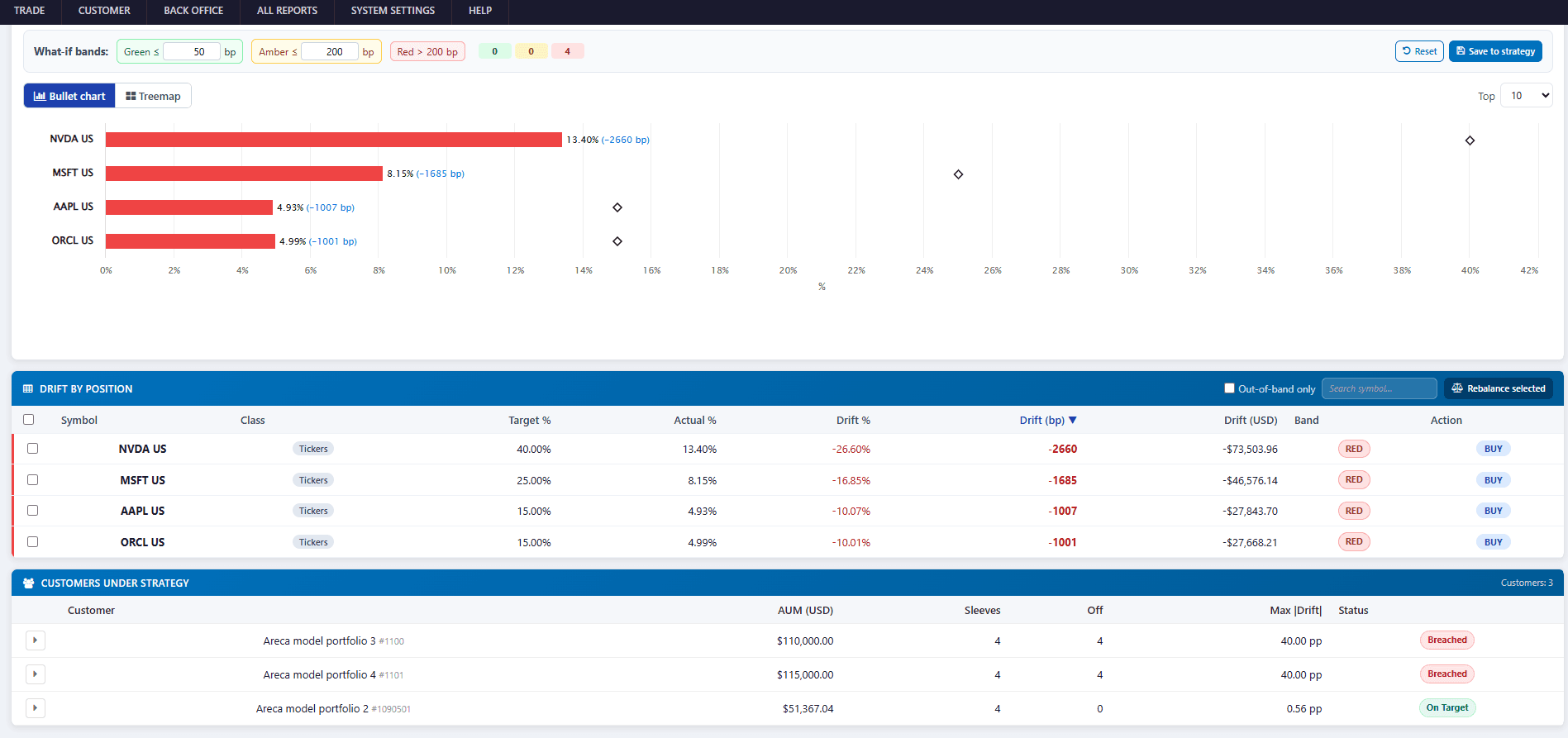
Also included: per-customer and per-symbol drill-downs across every account on a strategy, concentration monitoring with HHI and top-position alerts and breach counts, and bullet charts and treemaps for at-a-glance oversight.
Rebalancing & controlled execution
The rebalancing engine turns drift into action: calculate current versus target, generate buy / sell deltas, preview required quantities per account, then create parent order batches with child allocations back to each portfolio, segregated per-client or consolidated omnibus. Before orders are placed, every child allocation passes configured controls (buying power, cash availability, trading and order-size limits, instrument eligibility, account permissions, and client and portfolio restrictions) under a validate-then-transmit workflow with separated monitoring and execution privileges. Generation stays open to managers while execution stays governed.
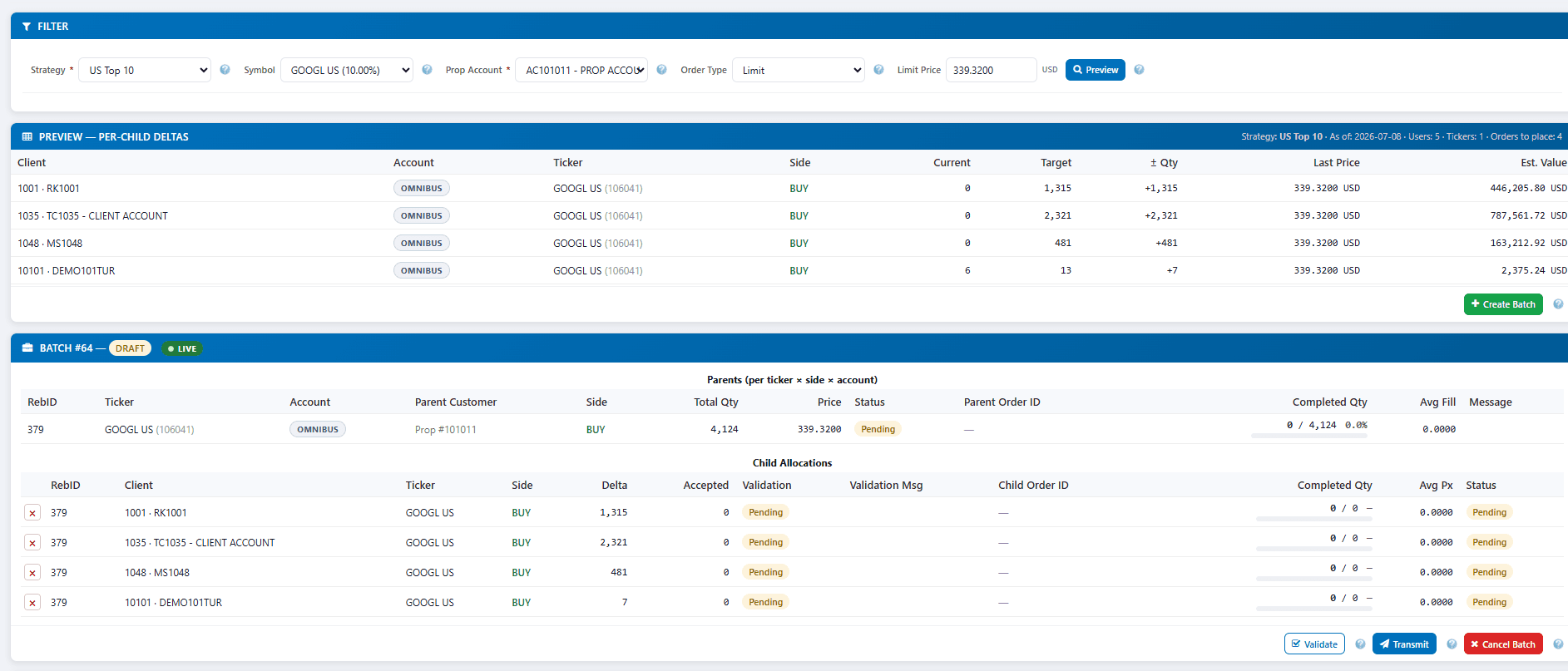
Built for real operations
No-trade tolerance bands. Per-strategy green / amber / red bands gate order generation, so positions within tolerance are never churned. What-if band simulation, savable to the strategy.
In-flight order awareness. Previews account for pending orders and unsettled cash, so weights hold steady while a batch is working and no phantom orders are generated.
Off-model close-out. Holdings outside the assigned model are surfaced as sell-to-target-zero rows in both drift monitoring and rebalancing.
Institutional-size baskets. Rebalance thousands of client accounts at once: large batches create, validate and transmit in chunks with live progress tracking and automatic retry.
Automatic fill allocation. A background watcher distributes parent fills pro-rata to child accounts at the parent's average fill price.
Order-level pre-trade gate. The same validation gate can run on every order a managed customer places, not only at rebalance time.
Historical drift analysis. Run the drift monitor as of any past date for review and audit conversations.
Duplicate-batch protection. Conflict guards refuse overlapping open batches on the same strategy or tickers, preventing double execution.
Manager enablement & oversight
Onboard internal or external portfolio managers onto the same infrastructure. Managers create and run strategies, monitor drift, and generate rebalancing batches from a self-service portal, operating only within the permissions, validation, and governance the institution defines. Operations and management get a consolidated view across strategy allocation, performance and NAV, drift and breaching-client reports, concentration and rebalance turnover, and batch and fill status, with Excel and PDF exports.
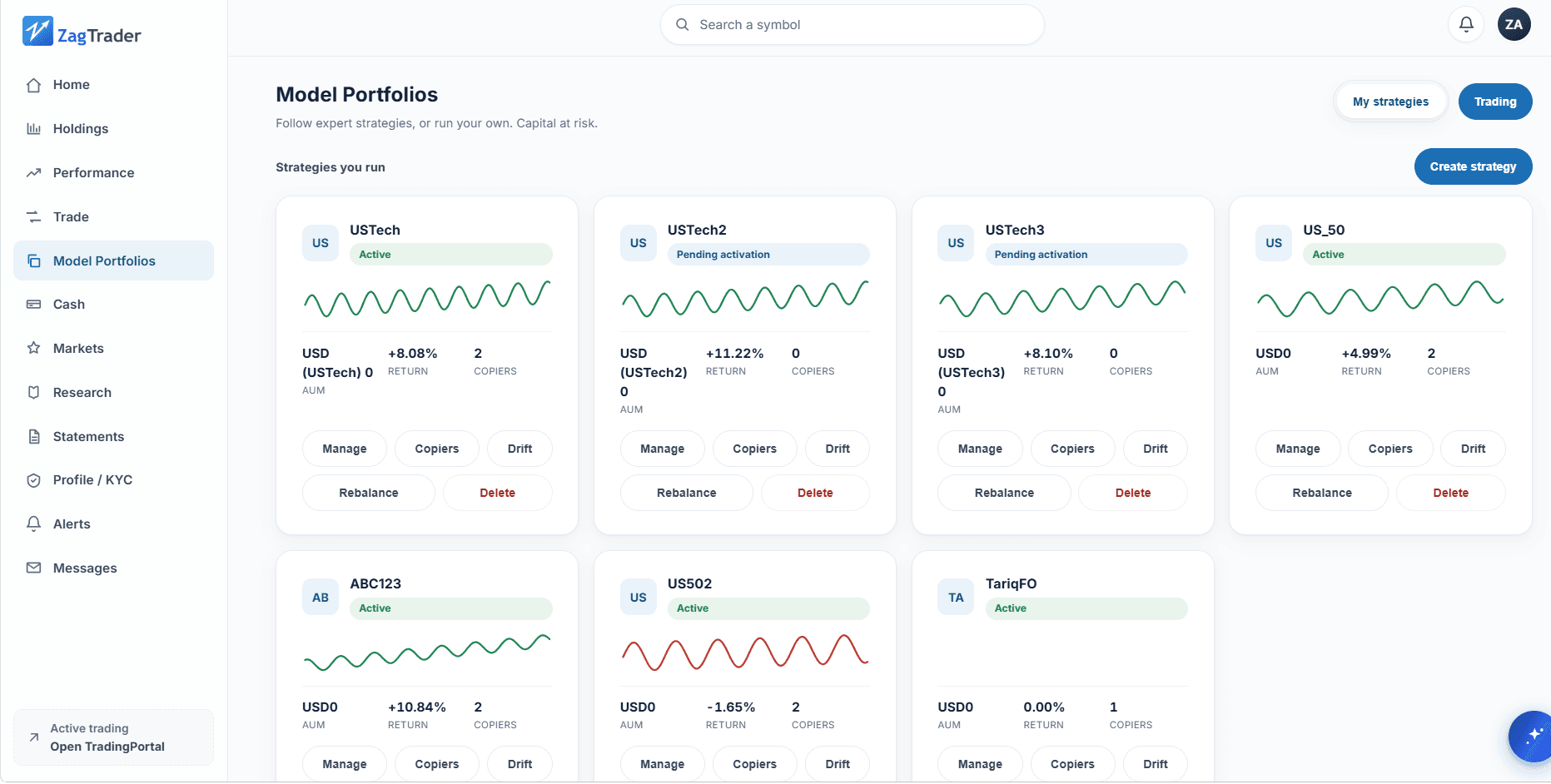
The same strategy engine also powers social and copy trading: advisors publish strategies that investors follow, with automatic replication across accounts. See Copy Trading & Strategy Management.
Ask the ZagTrader AI assistant about any holding or portfolio. See ZagTrader AI.
Screens shown are from a ZagTrader demonstration environment; all figures are illustrative.
Models, fees, reporting and coverage
The rest of the capability set, one row per area.
| Capability | What you get |
|---|---|
| Strategy builder | Model portfolios with target allocations across markets, sectors, asset classes, tickers, currencies and cash, entered by hand or imported from Excel or CSV and validated to 100%, with a risk-profile score per strategy. |
| Portfolio and manager mapping | Each strategy mapped to client portfolios, accounts or entities, recording the responsible internal or external portfolio manager, manager share, service settings, fee rules and reporting views. |
| Fees and success fees | Management, performance and success fees with fixed or index benchmarks, hurdle rates, minimum amounts and fee start dates. Fee runs generate draft journals for controlled posting. |
| Holdings and NAV | Multi-asset holdings with NAV calculation and real-time P&L tracking across every holding. |
| Advisory and robo-advisory | Discretionary, advisory and rules-driven robo mandates side by side, with strategy-based onboarding into model portfolios and automated, model-aligned rebalancing for advised accounts. |
| Client reporting | GIPS-compliant, branded consolidated statements, dashboards and presentations across a client's accounts and asset classes, with templates by region or segment, scheduled or on demand, in several languages and currencies, exportable to Excel or PDF. |
| Asset coverage | Traditional assets (equities, bonds, mutual funds, ETFs and cash), alternative investments (private equity, real estate, hedge funds and commodities) and digital assets (cryptocurrencies, tokenised securities and NFTs). |
Frequently asked questions
Who is Portfolio Management & Wealth for?
Asset managers, wealth managers and private banks running model portfolios and mandates across many client accounts, with internal or external portfolio managers.
How does rebalancing stay under control?
Orders are generated only for positions outside the tolerance band, grouped as parent orders with per-account child orders, and each child passes pre-trade validation before anything is transmitted. Fills are allocated back pro-rata automatically.
Which performance measures are included?
NAV, AUM, net flows, time-weighted return, money-weighted return (IRR) and realized P&L across configurable periods, with benchmark comparison and exports to Excel or PDF.
How is this different from the Investment Office?
Portfolio Management & Wealth runs model portfolios across many client accounts. The Investment Office is the book of record a family or investment office runs for its own beneficiaries, with consolidated custody, mandate limits, daily valuation and statements.
See a rebalance from model to allocated fill
Portfolio management is connected with trading, risk management, accounting, fees, and reporting, so decisions, controls, orders, executions, allocations, and reporting operate within the same environment.
100+ institutions run on ZagTrader technology, with $500B+ in client assets on the platform
Institutions that run on ZagTrader technology