
Platform · Connectivity
ZagTrader MT/MX Messaging: every MT and MX message processed, monitored and audited in one place
Full ISO 15022 (MT) coverage with ISO 20022 (MX) capability, connected through any SWIFT service bureau, with maker-checker control and live monitoring of every message.
In short
MT/MX Messaging is ZagTrader's dedicated layer for processing, monitoring and governing messages across settlement, custody, reconciliation and reporting, with full ISO 15022 (MT) coverage and ISO 20022 (MX) format capability. It exchanges MT and ISO 20022 (MX) messages over the Swift network, through any Swift service bureau, by secure file transfer or through a depository gateway. It puts maker-checker control and live monitoring on every message, and runs standalone beside your existing systems or inside ZagTrader.
- Standards
- ISO 15022 (MT), with ISO 20022 (MX) capability
- Connectivity
- Any SWIFT service bureau
- Deployment
- Standalone or inside ZagTrader
What operations and IT heads ask first
Which messages, how they flow, and who can see and approve them.
Every post-trade message type
Settlement, status, statements, corporate actions, payments and cash confirmations, inbound and outbound.
See message coverageStraight through, exceptions owned
Generate, validate, approve, dispatch, match and reconcile, with exceptions routed to owned queues.
See settlementAny SWIFT service bureau
Message queues, APIs and secure file transfer to custodians, agent banks, CSDs and CCPs.
See integration optionsLive monitoring
Dashboards by status and severity, stuck-message aging, fast filters and drill-down to the raw message.
See the componentsMaker-checker and full audit
Approvals on sensitive actions and configuration, with an end-to-end audit trail on every message.
See risk and complianceStandalone or integrated
Run beside your current OMS and post-trade stack, or as a native part of ZagTrader custody.
See custody and back officeWhy MT/MX Messaging
Message coverage & standards
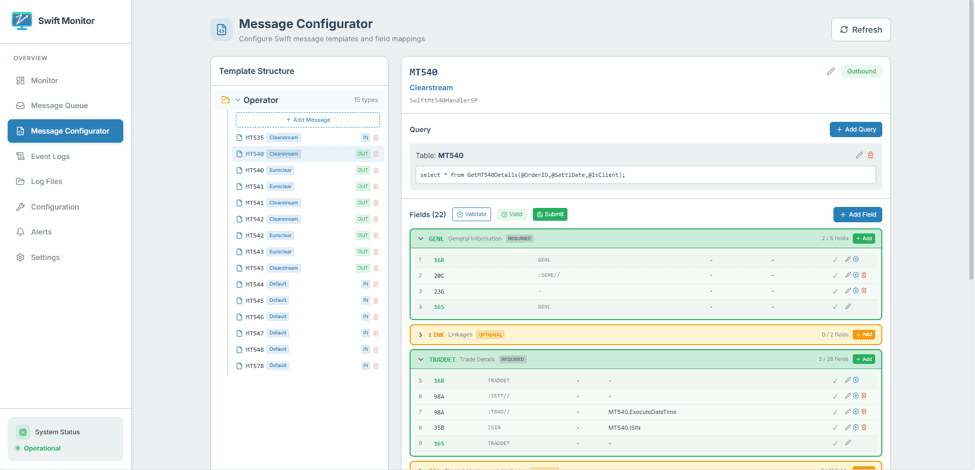
MT/MX Messaging provides full ISO 15022 (MT) message support with ISO 20022 (MX) format capability, built on a licensed, industry-proven SWIFT messaging library. Message templates, field mappings, and validation rules are managed through a visual configurator, so new message types and market-specific variations are introduced through configuration, not code changes.
| Category | Message types |
|---|---|
| Settlement instructions | MT540, MT541, MT542, MT543 |
| Settlement confirmations | MT544, MT545, MT546, MT547 |
| Status, processing commands & allegements | MT548, MT530, MT578 |
| Statements & reconciliation | MT535 (holdings), MT536 (transactions), MT537 (pending) |
| Corporate actions | MT564, MT565, MT566, MT568 |
| Cash transfers & payments | MT101, MT103, MT202, MT202COV, MT210 |
| Cash confirmations & statements | MT900, MT910, MT940, MT950 |
All listed message types are supported for both inbound and outbound flows. Additional types and market variations are added through template configuration.
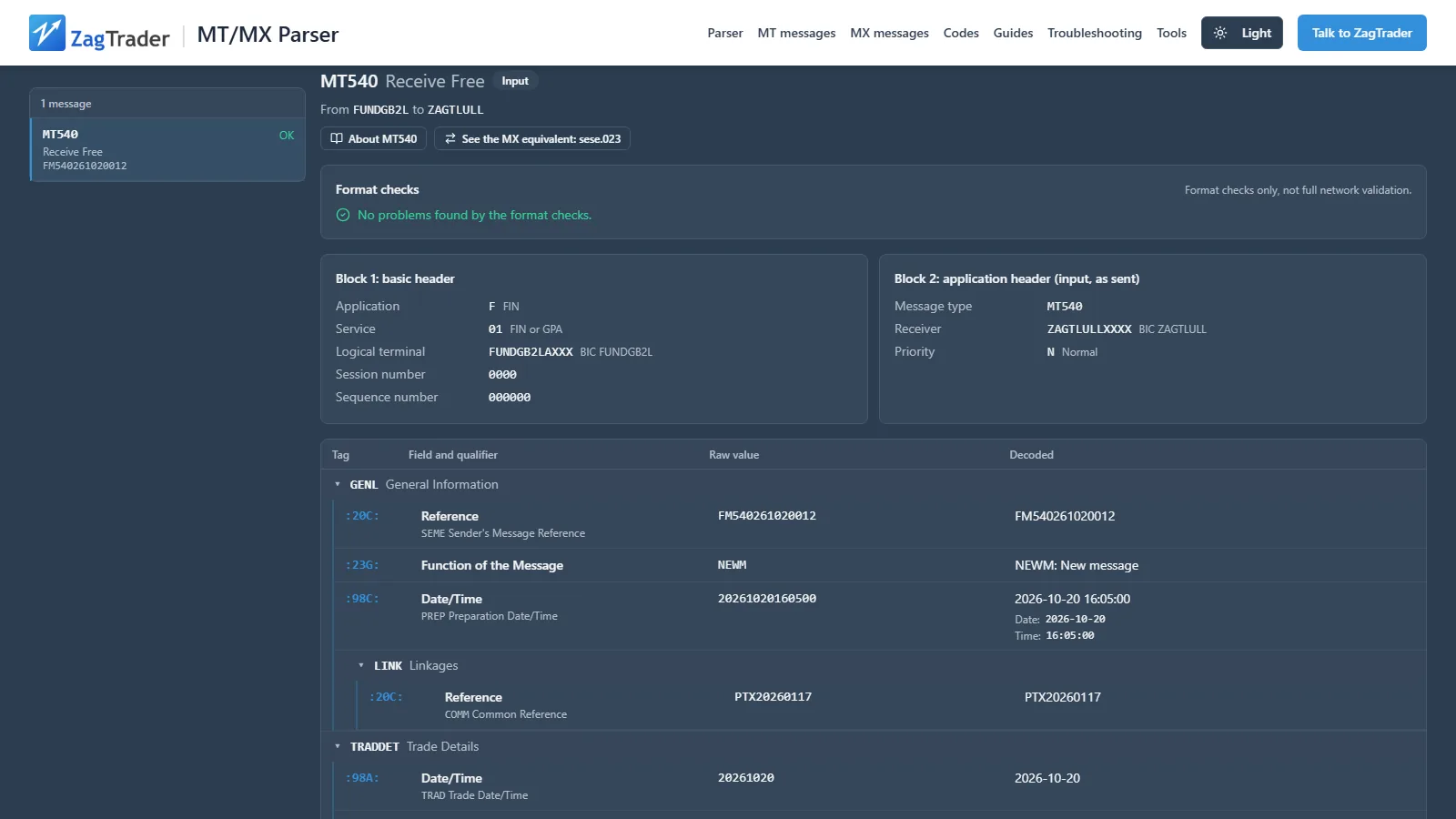
Look up any MT or MX message with our free parser
Decode MT and ISO 20022 messages with our free parser. Paste a message to see every block, field and code in plain English, or look up any MT or MX message type. It runs in your browser, so nothing is uploaded.
- Every MT block, field, sequence and qualifier decoded in plain English
- ISO 20022 XML shown as a tree, with the MT message that does the same job
- Status, reason and event codes explained, with what to do next
- Runs in your browser: nothing you paste is uploaded
Free to use, permanently, with no sign-up: ZagTrader's contribution to the banking community.
Inside MT/MX Messaging
Message configuration, live monitoring, and full audit trail in one environment


Straight-through processing
From instruction generation to reconciliation, the full message lifecycle runs straight through, with human intervention reserved for approvals and exceptions.
- 1
Generate: settlement instructions are generated automatically from post-trade activity.
- 2
Validate: message content is validated against templates, field mappings, and rules before release.
- 3
Approve: maker-checker approval gates sensitive actions before anything is dispatched.
- 4
Dispatch: instructions are dispatched to the SWIFT network through your service bureau.
- 5
Match: inbound confirmations are matched automatically against outgoing instructions.
- 6
Reconcile: statements of holdings and transactions are reconciled against internal positions.
Core components
Three building blocks: processing, connectivity, and oversight
Key capabilities
- Parsing, validation, and rules-based routing
- Message templates and field mappings by message type
- Maker-checker controls for sensitive actions and configuration changes
- Exception workflows with queues, ownership, and escalation paths
- Message replay and controlled reprocessing with full traceability
- Full audit logging across message lifecycle events
Key capabilities
- Bureau-agnostic: connects through any SWIFT service bureau via message queues, APIs, and secure file transfer
- Connectivity to custodians, agent banks, CSDs, and CCPs
- Integration with internal platforms (OMS, back office, reconciliation, compliance, data stores)
- Connectivity abstraction that isolates internal systems from network/provider changes
- Resilience controls including queuing behavior, retries, and timeouts
- Connectivity health and status visibility to distinguish processing vs connectivity delays
- Secure access controls aligned to enterprise operational governance
Key capabilities
- Live operational dashboards across status and severity (stuck, critical, completed, in-progress, rejected)
- Stuck-message detection with aging indicators to highlight items outside expected timelines
- Advanced filtering for fast triage (type, severity, operator, IDs, reference, date range)
- Investigation views with drill-down logs and searchable history
- Logical and raw message views to support validation and investigation
- End-to-end audit trail timeline for governance and root-cause analysis
- Exportable reporting to support oversight and operational reviews
- Role-based access controls to align actions with internal governance policies
Built for volume
Scales with your message flow as operations grow
120
messages / second peak throughput
6,000+
messages / minute sustained
<5 ms
response time from cache
2M+
messages stored and searchable
250
concurrent connections
Measured in internal performance testing of MT/MX Messaging.
Security & governance
Deployment options
Modernize MT and MX operations on your terms
Frequently asked questions
Which messages does MT/MX Messaging cover?
Settlement instructions (MT540 to MT543) and confirmations (MT544 to MT547); status, processing commands and allegements (MT548, MT530, MT578); statements (MT535, MT536, MT537); corporate actions (MT564, MT565, MT566, MT568); cash transfers and payments (MT101, MT103, MT202, MT202COV, MT210); and cash confirmations and statements (MT900, MT910, MT940, MT950). All are supported inbound and outbound, and new types are added through template configuration.
Do we have to replace our existing systems?
No. MT/MX Messaging can run as a standalone MT/MX messaging layer beside your existing OMS and post-trade stack, or as a native extension of ZagTrader custody and post-trade workflows for deeper straight-through automation.
How does it connect to the SWIFT network?
Through any SWIFT service bureau, using message queues, APIs and secure file transfer. MT/MX Bridge connects to custodians, agent banks, CSDs and CCPs and to your internal OMS, back office, reconciliation and compliance systems, with retries, timeouts and connectivity health shown separately from processing delays.
How much message volume can it handle?
In internal performance testing, MT/MX Messaging reached 120 messages a second at peak and sustained more than 6,000 a minute, with responses under 5 ms from cache, 2M+ messages stored and 250 concurrent connections.
Centralise and control your MT and MX operations
See how MT/MX Messaging standardises message processing, monitoring, and governance across the post-trade lifecycle.
100+ institutions run on ZagTrader technology, with $500B+ in client assets on the platform
Institutions that run on ZagTrader technology